
Overview of EPSI
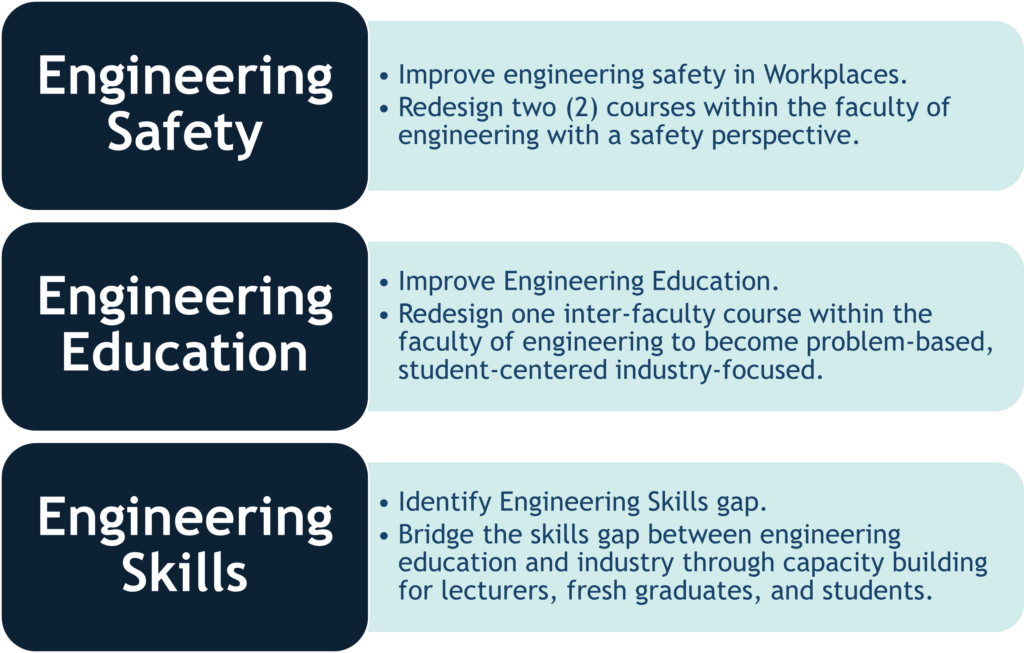
Focus Areas
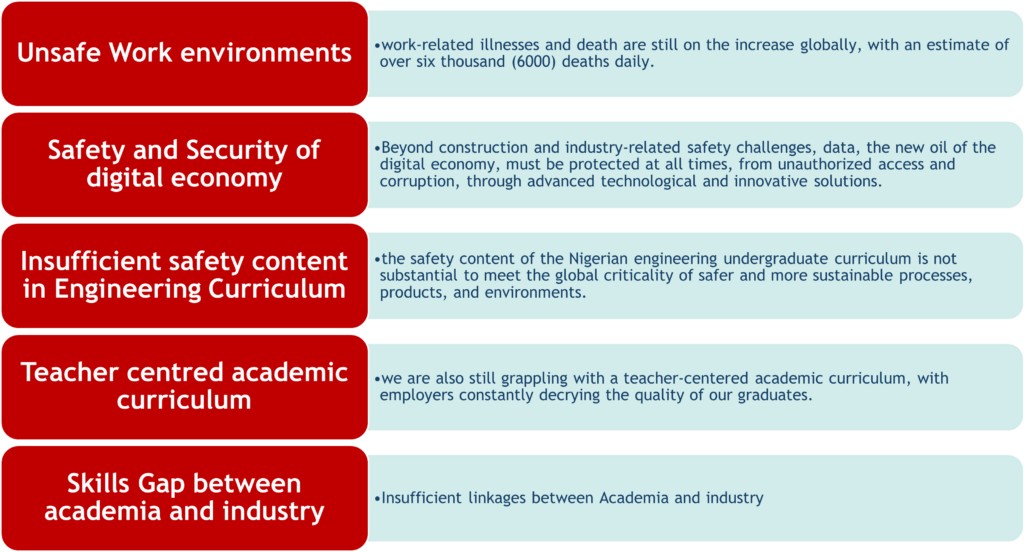
Problem Statement
Theory of Change Framework
Goals WHAT
- Redesign two(2) courses within the faculty of engineering with a safety perspective
- Redesign one inter-faculty course within the faculty of engineering to become problem-based, student-centered industry-focused.
- Bridge the skills gap between engineering education and industry through capacity building for lecturers, fresh graduates and students.
Input
Fifty Thousand Pounds (£50,000)
Activities
- Scientific surveys
- Academic Research
- Course Redesign
- Staff Training and Workshops
- Training of fresh graduates/students
- Academic Publications
- Advocacy for National engineering education review
Objectives “How”
- Study materials on safety in engineering
- Study national and international safety standards and specifications
- consult industry experts to provide insights on industry practice on safety
- Identify courses in engineering disciplines with critical need for safety content (syllabus)
- Integrate lessons from )a)-(d) above to redesign two courses within the faculty with safety in mind.
- Form an engineering education research group
- Consult engineering experts in different industries to identify industry needs
- Interview engineering students to identify their expectations/perceptions of engineering education
- Study existing student-centered industry-focused engineering pedagogies
- Integrate findings from (g)-(l) above to redesign one current multidisciplinary course to with a student-centered and industry-focused pedagogy.
- Training of fresh graduates/students on redesigned courses and selected industry relevant skills
- Organizing and engineering career fair
- Training of lecturers by industry experts and engineering problem-based curriculum experts
- Workshops, Sensitization and Drive for proposal buy-in
Outputs
- Two(2) departmental courses in the faculty of Engineering redesign with safety in mind
- One(1) multidisciplinary course redesign using a student-centered industry=focused pedagogy
- Pilot study using the redesigned courses
- Fourty(40) students/fresh graduates trained on selected industry-relevant industry-focused pedagogy
- Twenty(20) lecturers trained on new course content and specialised industry-relevant topics
- An engineering education research group established and registered
- Two (2) research publications
- Two conference presentations
- An engineering career fair with a total of at least two hundred students in attendance
Outcomes
- Scientifically redesigned courses adapted with the Nigerian system in mind
- Improved knowledge and awareness of safety among staff and students
- Improved knowledge and awareness of industry skills and requirements among staff and students
- safer engineering practices and infrastructure
- Industry-ready graduates
- Enhanced industry-academia collaboration
- Improved graduation rate among engineering graduates
Impact
- Safer society
- Richer engineering education
- Higher employment rate for engineering graduates
- Higher enrolment rate into engineering courses
- Faster technological development of Nigeria
- over one thousand (1,000) students expected to benefit from the developed contents.
Risks: A major risk of the project include frequent disruption in academic activities due to industrial actions. We will address this by conducting virtual/remote activities when necessary. Another risk of the project is the kick-back by Lectures to the imminent change. We are addressing this by taking away the hard work of research and course redesign from them, as well as ensuring at all times that our proposals are in line with regulatory bodies.
